Why Do People With Lower Iqs Make More Babies
The relationship betwixt fertility and intelligence has been investigated in many demographic studies. In that location is evidence that, on a population level, intelligence is negatively correlated with fertility rate and positively correlated with survival rate of offspring.[1] It is postulated that, if the changed correlation of IQ with fertility rate is stronger than the correlation of IQ with survival rate, and if the correlation betwixt IQ and fertility tin can be linked to genetic factors, then the hereditary component of IQ volition subtract with every new generation, eventually giving rising to a 'reversed Flynn event', equally has been observed in Norway, Denmark, Australia, Britain, the Netherlands, Sweden, Finland, French republic and German-speaking countries, where a slow decline in boilerplate IQ scores has been noted since the 1990s.[2] [three] [four] [5] While the Flynn effect demonstrates an increase in phenotypic IQ scores over time in most other countries, confounding environmental factors during the same menstruum of time foreclose any determination concerning underlying change in genotypic IQ. Other correlates of IQ include income and educational attainment,[half-dozen] which are likewise fertility factors that are inversely correlated with fertility charge per unit, and are to some degree heritable.
Although fertility measures offspring per adult female, if i needs to predict population-level changes, the average age of motherhood likewise needs to be considered, with lower age of motherhood potentially having a greater effect than fertility charge per unit. For example, a subpopulation with fertility rate of 4 with average age of reproduction at xl years old, mostly speaking, will take relatively less genotypical growth than a subpopulation with fertility rate of 3 but average age of reproduction at xx years old.
Early on views and inquiry [edit]
The negative correlation between fertility and intelligence (equally measured by IQ) has been argued to have existed in many parts of the world. Early studies, however, were "superficial and illusory" and not clearly supported by the limited data they nerveless.[1]
Some of the outset studies into the subject were carried out on individuals living before the advent of IQ testing, in the tardily 19th century, by looking at the fertility of men listed in Who's Who, these individuals being presumably of high intelligence. These men, taken equally a whole, had few children, implying a correlation.[7] [8]
Nobel Prize–winning physicist William Shockley controversially argued from the mid-1960s through the 1980s that "the future of the population was threatened because people with low IQs had more children than those with high IQs."[nine] [10]
In 1963, Weyl and Possony asserted that comparatively small differences in average intelligence can become very large differences in the very high IQ ranges. A pass up in average psychometric intelligence of merely a few points will mean a much smaller population of gifted individuals.[11]
More rigorous studies carried out on Americans alive later the Second World War returned unlike results suggesting a slight positive correlation with respect to intelligence. The findings from these investigations were consistent enough for Osborn and Bajema, writing as late every bit 1972, to conclude that fertility patterns were eugenic, and that "the reproductive trend toward an increment in the frequency of genes associated with higher IQ... will probably proceed in the foreseeable time to come in the United States and will be found as well in other industrial welfare-state democracies."[12]
Several reviewers considered the findings premature, arguing that the samples were nationally unrepresentative, generally existence confined to whites born between 1910 and 1940 in the Great Lakes States.[13] [fourteen] Other researchers began to report a negative correlation in the 1960s afterward two decades of neutral or positive fertility.[15]
In 1982, Daniel R. Vining, Jr. sought to address these issues in a big study on the fertility of over 10,000 individuals throughout the U.s., who were then aged 25 to 34. The average fertility in his study was correlated at −0.86 with IQ for white women and −0.96 for black women. Vining argued that this indicated a drop in the genotypic average IQ of ane.half dozen points per generation for the white population, and 2.4 points per generation for the blackness population.[16] In considering these results along with those from earlier researchers, Vining wrote that "in periods of rising nascency rates, persons with higher intelligence tend to take fertility equal to, if not exceeding, that of the population equally a whole," merely, "The recent decline in fertility thus seems to take restored the dysgenic trend observed for a comparable period of falling fertility between 1850 and 1940." To address the business that the fertility of this sample could not be considered complete, Vining carried out a follow-upward written report for the same sample 18 years afterwards, reporting the aforementioned, though slightly decreased, negative correlation betwixt IQ and fertility.[17]
Afterwards research [edit]
In a 1988 report, Retherford and Sewell examined the association betwixt the measured intelligence and fertility of over 9,000 high school graduates in Wisconsin in 1957, and confirmed the inverse relationship between IQ and fertility for both sexes, but much more so for females. If children had, on boilerplate, the same IQ as their parents, IQ would decline by .81 points per generation. Taking .71 for the additive heritability of IQ as given by Jinks and Fulker,[xviii] they calculated a dysgenic decline of .57 IQ points per generation.[19]
Another mode of checking the negative relationship between IQ and fertility is to consider the relationship which educational attainment has to fertility, since education is known to be a reasonable proxy for IQ, correlating with IQ at .55;[20] in a 1999 written report examining the relationship between IQ and education in a large national sample, David Rowe and others found not simply that achieved teaching had a loftier heritability (.68) and that half of the variance in pedagogy was explained by an underlying genetic component shared past IQ, teaching, and SES.[21] One study investigating fertility and education carried out in 1991 found that high school dropouts in the United states of america had the near children (ii.5 on average), with high school graduates having fewer children, and college graduates having the fewest children (1.56 on average).[22]
The Bell Curve (1994) argued that the average genotypic IQ of the United states of america was failing due to both dysgenetic fertility and large calibration immigration of groups with low average IQ.[ citation needed ]
In a 1999 study Richard Lynn examined the human relationship between the intelligence of adults aged forty and above and their numbers of children and their siblings. Data was collected from a 1994 National Opinion Research Center survey among a representative sample of 2992 English-speaking individuals aged eighteen years. He found negative correlations between the intelligence of American adults and the number of children and siblings that they had, but just for females. He also reported that there was about no correlation between women's intelligence and the number of children they considered platonic.[23]
In 2004 Lynn and Marian Van Court attempted a straightforward replication of Vining's piece of work. Their study returned like results, with the genotypic decline measuring at 0.9 IQ points per generation for the total sample and 0.75 IQ points for whites simply.[24]
Boutwell et al. (2013) reported a strong negative association between county-level IQ and canton-level fertility rates in the U.s..[25]
A 2014 report by Satoshi Kanazawa using data from the National Kid Development Report found that more than intelligent women and men were more likely to want to exist childless, but that only more intelligent women – not men – were more likely to actually be childless.[26]
International research [edit]
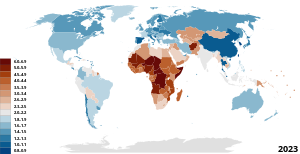
Although much of the inquiry into intelligence and fertility has been restricted to individuals inside a unmarried nation (usually the United States), Steven Shatz (2008) extended the research internationally; he finds that "There is a strong tendency for countries with lower national IQ scores to have higher fertility rates and for countries with higher national IQ scores to have lower fertility rates."[27]
Lynn and Harvey (2008) found a correlation of −0.73 betwixt national IQ and fertility. They estimated that the issue had been "a decline in the world'southward genotypic IQ of 0.86 IQ points for the years 1950–2000. A further decline of 1.28 IQ points in the globe'south genotypic IQ is projected for the years 2000–2050." In the first menses this upshot had been compensated for by the Flynn event causing a rise in phenotypic IQ but recent studies in four developed nations had found it has now ceased or gone into reverse. They idea information technology probable that both genotypic and phenotypic IQ will gradually start to decline for the whole world.[28]
Possible causes [edit]
Income [edit]
A theory to explain the fertility-intelligence relationship is that while income and IQ are positively correlated,[6] income is also in itself a fertility cistron that correlates inversely with fertility, that is, the college the incomes, the lower the fertility rates and vice versa.[29] [30] There is thus an changed correlation between income and fertility inside and betwixt nations. The college the level of didactics and GDP per capita of a human population, sub-population or social stratum, the fewer children are born. In a 1974 UN population conference in Bucharest, Karan Singh, a former government minister of population in India, encapsulated this relationship past stating "Evolution is the best contraceptive".[31]
Didactics [edit]
In about countries, education is inversely correlated to childbearing. People often delay childbearing in lodge to spend more fourth dimension getting instruction, and thus have fewer children. Conversely, early childbearing can interfere with teaching, so people with early or frequent childbearing are probable to be less educated. While instruction and childbearing place competing demands on a person's resources, education is positively correlated with IQ.
While there is less research into men'southward fertility and teaching, in developed countries evidence suggests that highly-educated men display higher levels of childbearing compared to less-educated men.[32] [33]
Every bit a country becomes more developed, education rates increase and fertility rates decrease for both men and women. Fertility has fallen faster for both less-educated men and women than it has for highly-educated men and women. In the Nordic countries of Kingdom of denmark, Norway, and Sweden, fertility for less-educated women has now fallen enough that childlessness is now highest among the least educated women just as it is for men.[34]
Birth control and intelligence [edit]
Amidst a sample of women using nascence control methods of comparable theoretical effectiveness, success rates were related to IQ, with the percentages of high, medium and depression IQ women having unwanted births during a three-yr interval beingness 3%, viii% and 11%, respectively.[35] Since the effectiveness of many methods of birth control is directly correlated with proper usage, an alternative interpretation of the data would signal lower IQ women were less likely to utilise birth control consistently and correctly. Another report institute that after an unwanted pregnancy has occurred, higher IQ couples are more likely to obtain abortions;[36] and single teenage girls who become pregnant are institute to be more than likely to carry their babies to term if they are doing poorly in school.[37]
Conversely, while desired family unit size in the United States is plainly the same for women of all IQ levels,[16] [ dubious ] highly educated women are found to exist more likely to say that they want more than children than they have, indicating a "deficit fertility" in the highly intelligent.[38] In her review of reproductive trends in the United States, Van Court argues that "each cistron – from initially employing some class of contraception, to successful implementation of the method, to termination of an accidental pregnancy when information technology occurs – involves selection against intelligence."[39]
Criticisms [edit]
While it may seem obvious that such differences in fertility would consequence in a progressive change of IQ, Preston and Campbell (1993) argued that this is a mathematical fallacy that applies only when looking at closed subpopulations. In their mathematical model, with constant differences in fertility, since children's IQ tin can exist more than or less than that of their parents, a steady-state equilibrium is argued to be established betwixt dissimilar subpopulations with different IQ. The mean IQ will not modify in the absence of a change of the fertility differences. The steady-state IQ distribution volition be lower for negative differential fertility than for positive, merely these differences are minor. For the extreme and unrealistic assumption of endogamous mating in IQ subgroups, a differential fertility change of 2.5/1.five to ane.v/2.five (loftier IQ/low IQ) causes a maximum shift of four IQ points. For random mating, the shift is less than ane IQ betoken.[forty] James S. Coleman, yet, argues that Preston and Campbell's model depends on assumptions which are unlikely to exist true.[41] [42]
The general increase in IQ test scores, the Flynn outcome, has been argued to exist prove confronting dysgenic arguments. Geneticist Steve Connor wrote that Lynn, writing in Dysgenics: Genetic Deterioration in Modern Populations, "misunderstood modern ideas of genetics." "A flaw in his statement of genetic deterioration in intelligence was the widely accustomed fact that intelligence as measured by IQ tests has actually increased over the past 50 years."[43] If the genes causing IQ have been adversely affected, IQ scores should reasonably be expected to modify in the same management, still the reverse has occurred. However, it has been argued that genotypic IQ may decrease even while phenotypic IQ rises throughout the population due to ecology effects such as amend nutrition and education.[19] The Flynn event may at present take ended or reversed in some developed nations.[44] [45]
Some of the studies looking at relation between IQ and fertility comprehend the fertility of individuals who have attained a detail age, thereby ignoring positive correlation between IQ and survival. To make conclusions about effects on IQ of future populations, such furnishings would have to be taken into account.[ citation needed ]
Contempo inquiry has shown that education and socioeconomic condition are ameliorate indicators of fertility and suggests that the relationship betwixt intelligence and number of children may exist spurious. When controlling for education and socioeconomic condition, the human relationship between intelligence and number of children, intelligence and number of siblings, and intelligence and ideal number of children reduces to statistical insignificance. Amid women, a postal service-hoc analysis revealed that the lowest and highest intelligence scores did not differ significantly by number of children.[46] Even so, socioeconomic condition and (manifestly) didactics are themselves not independent of intelligence.[ citation needed ]
Most research involves studying female fertility, while male fertility is ignored. When male fertility rates are compared to educational activity attainment men with more education father more children.[47]
Other enquiry propose that siblings born further apart reach college educational outcomes. Therefore, sibling density, non number of siblings, may explicate the negative association betwixt IQ and number of siblings.[46]
Other traits [edit]
A study by the Institute of Psychiatry determined that men with higher IQ's tend to accept meliorate quality sperm than lower IQ males, even when considering age and lifestyle, stating that the genes underlying intelligence may be multi-factored.[48]
See also [edit]
- Dysgenics
- Fertility-development controversy
- Fertility factor (demography)
- List of countries and territories by fertility rate
Notes [edit]
- ^ a b Graff HJ (March 1979). "Literacy, education, and fertility, past and present: A critical review". Population and Evolution Review. v (1): 105–40. doi:x.2307/1972320. JSTOR 1972320.
- ^ Teasdale, Thomas West; Owen, David R (2005). "A long-term ascension and recent decline in intelligence test performance: The Flynn Effect in reverse". Personality and Individual Differences. 39 (four): 837–43. doi:ten.1016/j.paid.2005.01.029.
- ^ Dutton, Edward; Lynn, Richard (2013). "A negative Flynn event in Finland, 1997–2009". Intelligence. 41 (half dozen): 817–20. doi:10.1016/j.intell.2013.05.008.
- ^ Pietschnig, Jakob; Gittler, Georg (2015). "A reversal of the Flynn effect for spatial perception in German language-speaking countries: Evidence from a cross-temporal IRT-based meta-analysis (1977–2014)". Intelligence. 53: 145–53. doi:x.1016/j.intell.2015.x.004.
- ^ Bratsberg, Bernt; Rogeberg, Ole (June six, 2018). "Flynn effect and its reversal are both environmentally acquired". Proceedings of the National Academy of Sciences. 115 (26): 6674–78. doi:10.1073/pnas.1718793115. ISSN 0027-8424. PMC6042097. PMID 29891660.
- ^ a b Geary DM (2004). The Origin of the Mind: Evolution of Brain, Cognition, and Full general Intelligence. American Psychological Clan (APA). ISBN978-1-59147-181-3. OCLC 217494183.
- ^ Huntington E, Whitney L (1927). The Builders of America. New York: Morrow.
- ^ Kirk D (1957). "The fertility of a gifted group: A report of the number of children of men in WHO'S WHO.". The Nature and Manual of the Genetic and Cultural Characteristics of Homo Populations. New York: Milbank Memorial Fund. pp. 78–98.
- ^ "William Shockley 1910–1989". A Science Odyssey People and Discoveries. PBS online. 1998. Retrieved 2006-11-13 .
- ^ Shockley West, Pearson R (1997). Shockley on Eugenics and Race: The Awarding of Science to the Solution of Human Problems. Scott-Townsend Publishers. ISBN978-one-878465-03-0.
- ^ Weyl N, Possony ST (1963). The Geography of Intellect. p. 154.
- ^ Osborn F, Bajema CJ (December 1972). "The eugenic hypothesis". Social Biological science. 19 (4): 337–45. doi:ten.1080/19485565.1972.9988006. PMID 4664670.
- ^ Osborne RT (December 1975). "Fertility, IQ and schoolhouse achievement". Psychological Reports. 37 (3 PT two): 1067–73. doi:x.2466/pr0.1975.37.3f.1067. PMID 1208722. S2CID 31954683.
- ^ Cattell RB (1974). "Differential fertility and normal pick for IQ: some required conditions in their investigation". Social Biology. 21 (ii): 168–77. doi:10.1080/19485565.1974.9988103. PMID 4439031.
- ^ Kirk D (Nov 1969). "The biological effects of family planning. B. The genetic implications of family planning". Journal of Medical Education. 44 (11): Suppl two:80–3. doi:10.1097/00001888-196911000-00031. PMID 5357924.
- ^ a b Vining Jr DR (1982). "On the possibility of the reemergence of a dysgenic trend with respect to intelligence in American fertility differentials". Intelligence. 6 (3): 241–64. doi:ten.1016/0160-2896(82)90002-2. PMID 12265416.
- ^ Vining D (1995). "On the possibility of the reemergence of a dysgenic trend with respect to intelligence in American fertility differentials: an update". Personality and Individual Differences. 19 (2): 259–263. doi:10.1016/0191-8869(95)00038-8.
- ^ Jinks JL, Fulker DW (May 1970). "Comparison of the biometrical genetical, MAVA, and classical approaches to the analysis of human behavior". Psychological Bulletin. 73 (5): 311–49. doi:10.1037/h0029135. PMID 5528333. S2CID 319948.

- ^ a b Retherford RD, Sewell WH (1988). "Intelligence and family unit size reconsidered" (PDF). Social Biology. 35 (one–two): ane–40. doi:10.1080/19485565.1988.9988685. PMID 3217809.
- ^ Neisser U, Boodoo G, Bouchard Jr TJ, Boykin AW, Brody N, Ceci SJ, et al. (1996). "Intelligence: Knowns and unknowns". American Psychologist. 51 (ii): 77–101. doi:10.1037/0003-066X.51.two.77. S2CID 20957095.
- ^ Rowe D (1998). "Herrnstein's syllogism: genetic and shared ecology influences on IQ, education, and income". Intelligence. 26 (4): 405–423. doi:10.1016/S0160-2896(99)00008-2.
- ^ Bachu A (October 1991). "Fertility of American women: June 1990". Current Population Reports. Series P-20, Population Characteristics. U.Southward. Bureau of the Census. Current Population Study Series. U.S. Government Printing Function (454): i-1–69. PMID 12158801.
- ^ Lynn R (1999). "New evidence for dysgenic fertility for intelligence in the United States". Social Biology. 46 (1–2): 146–53. doi:10.1080/19485565.1999.9988992. PMID 10842506.
- ^ Lynn R (2004). "New testify of dysgenic fertility for intelligence in the United States". Intelligence. 32 (2): 193–201. doi:10.1016/j.intell.2003.09.002. PMID 10842506.
- ^ Boutwell BB, Franklin TW, Barnes JC, Beaver KM, Deaton R, Lewis RH, et al. (2013-09-01). "County-level IQ and fertility rates: A fractional test of Differential-Thousand theory". Personality and Individual Differences. 55 (5): 547–552. doi:x.1016/j.paid.2013.04.018. ISSN 0191-8869.
- ^ Kanazawa S (Nov 2014). "Intelligence and childlessness". Social Science Research. 48: 157–70. doi:10.1016/j.ssresearch.2014.06.003. PMID 25131282.
- ^ Shatz S (2008). "IQ and fertility: A cross-national report". Intelligence. 36 (2): 109–111. doi:10.1016/j.intell.2007.03.002.
- ^ Lynn R, Harvey J (2008). "The decline of the world'southward IQ". Intelligence. 36 (2): 112–120. doi:ten.1016/j.intell.2007.03.004.
- ^ "Income as a determinant of declining Russian fertility; Trevitt, Jamie; Public Policy; xviii-April-2006". Archived from the original on 2009-02-twenty. Retrieved 2008-07-02 .
- ^ Freedman DS (1963). "The Relation of Economic Status to Fertility". The American Economical Review. 53 (3): 414–426. JSTOR 1809165.
- ^ Weil DN (2004). Economic Growth. Addison-Wesley. p. 111. ISBN978-0-201-68026-3.
- ^ Jalovaara M, Neyer Thousand, Andersson M, Dahlberg J, Dommermuth Fifty, Fallesen P, Lappegård T (July 2019). "Education, Gender, and Cohort Fertility in the Nordic Countries" (PDF). European Journal of Population. 35 (3): 563–586. doi:x.1007/s10680-018-9492-2. PMC6639448. PMID 31372105.
- ^ Miettinen A, Rotkirch A, Szalma I, Donno A, Tanturri ML. "Increasing childlessness in Europe: fourth dimension trends and country differences" (PDF). Families and Societies.
- ^ Jalovaara M, Neyer Grand, Andersson Thou, Dahlberg J, Dommermuth Fifty, Fallesen P, Lappegård T (July 2019). "Education, Gender, and Cohort Fertility in the Nordic Countries". European Journal of Population. 35 (three): 563–586. doi:ten.1007/s10680-018-9492-2. PMC6639448. PMID 31372105.
- ^ Udry JR (1978). "Differential fertility by intelligence: the role of birth planning". Social Biology. 25 (1): ten–4. doi:10.1080/19485565.1978.9988313. PMID 653365.
- ^ Cohen JE (March 1971). "Legal abortions, socioeconomic status, and measured intelligence in the United states". Social Biology. 18 (1): 55–63. doi:x.1080/19485565.1971.9987900. PMID 5580587. S2CID 1843957.
- ^ Olson Fifty (July 1980). "Social and psychological correlates of pregnancy resolution amongst adolescent women: a review". The American Journal of Orthopsychiatry. l (three): 432–445. doi:10.1111/j.1939-0025.1980.tb03303.x. PMID 7406028.
- ^ Weller RH (1974). "Excess and deficit fertility in the United States, 1965". Social Biology. 21 (ane): 77–87. doi:10.1080/19485565.1974.9988091. PMID 4851952.
- ^ Van Court Grand (1983). "Unwanted Births And Dysgenic Reproduction In The United States". Eugenics Bulletin.
- ^ Preston SH, Campbell C (March 1993). "Differential Fertility and the Distribution of Traits: The Case of IQ". The American Periodical of Sociology. 98 (5): 997–1019. doi:10.1086/230135. JSTOR 2781579. S2CID 143653371.
- ^ Coleman JS (1993). "Comment on Preston and Campbell's 'Differential Fertility and the Distribution of Traits'". The American Journal of Sociology. 98 (five): 1020–1032. doi:ten.1086/230136. JSTOR 2781580. S2CID 144461577.
- ^ Lam D (March 1993). "Annotate on Preston and Campbell'south "Differential Fertility and the Distribution of Traits"". The American Journal of Folklore. 98 (v): 1033–1039. doi:10.1086/230137. JSTOR 2781581. S2CID 145151340.
- ^ Connor S (December 22, 1996). "Stalking the Wild Taboo; Professor predicts genetic decline and fall of man". The Dominicus Times. Archived from the original on 2008-07-23. Retrieved 2008-04-xv .
- ^ Teasdale T, Owen DR (2008). "Secular declines in cognitive exam scores: A reversal of the Flynn Issue". Intelligence. 36 (two): 121–126. doi:x.1016/j.intell.2007.01.007.
- ^ Lynn R, Harvey J (2008). "The refuse of the world's IQ". Intelligence. 36 (ii): 112–120. doi:10.1016/j.intell.2007.03.004.
- ^ a b Parker MP (2004). "Intelligence and dysgenic fertility: Re-specification and reanalysis" (PDF). Chrestomathy: Almanac Review of Undergraduate Enquiry at the College of Charleston (3): 167–81. S2CID 39817063. Archived from the original (PDF) on 2018-02-26.
- ^ https://www.cairn-int.info/commodity-E_POPSOC_548_0001--across-the-globe-is-men-due south-fertility.htm
- ^ "Intelligent 'have better sperm'". BBC. v Dec 2008.
Source: https://en.wikipedia.org/wiki/Fertility_and_intelligence
0 Response to "Why Do People With Lower Iqs Make More Babies"
إرسال تعليق