Museum of Fine Arts Houston 1001 Bissonnet St Houston Tx 77005
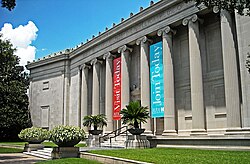 Watkin Building | |
 | |
| Established | 1900 |
|---|---|
| Location | 1001 Bissonnet Houston, TX 77005 Us |
| Coordinates | 29°43′32.5″Northward 95°23′25.5″West / 29.725694°N 95.390417°W / 29.725694; -95.390417 Coordinates: 29°43′32.5″N 95°23′25.v″West / 29.725694°N 95.390417°W / 29.725694; -95.390417 |
| Blazon | Art Museum, Institute, Library, Sculpture Park[1] |
| Director | Gary Tinterow |
| Public transit admission | Red Line |
| Website | www |
The Museum of Fine Arts, Houston (MFAH), is an art museum located in the Houston Museum District of Houston, Texas. It is i of the largest art museums in the United States. With the contempo completion of an eight yr campus redevelopment project, including the opening of the Nancy and Rich Kinder Edifice in 2020, it is the twelfth largest art museum in the world based on square anxiety of gallery space.[2] The permanent collection of the museum spans more than 6,000 years of history with approximately lxx,000 works from six continents.[three]
Facilities [edit]
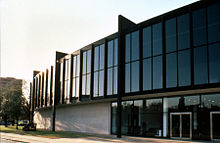
Caroline Wiess Police force Building
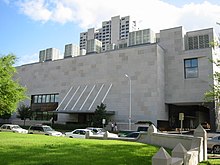
Audrey Jones Beck Building

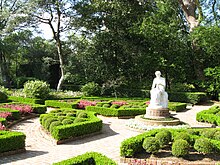
Gardens at Bayou Bend, donated by Ima Hogg
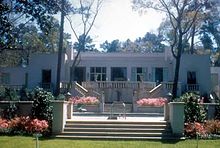
The MFAH's permanent collection totals well-nigh seventy,000 pieces in over 300,000 foursquare feet (28,000 m2) of exhibition space,[4] placing it amidst the larger fine art museums in the Usa. The museum's collections and programs are housed in nine facilities. The Susan and Fayez S. Sarofim Campus encompasses 14 acres including vii of the facilities, with two boosted facilities, Bayou Bend and Rienzi (house museums) at off site locations. The main public collections and exhibitions are in the Law, Beck, and Kinder buildings.[5] [half-dozen] The Police and Beck buildings have over 130,000 square feet (12,000 m2) of exhibition infinite.[7]
The Susan and Fayez S. Sarofim Campus [edit]
- Caroline Wiess Constabulary Building – the original neo-classical building was designed in phases by architect William Ward Watkin. The original Caroline Wiess Constabulary building was constructed in 1924 and the east and w wing were added in 1926. The Robert Lee Blaffer Memorial Wing was designed by Kenneth Franzheim and opened to the public in 1953. The new construction included meaning structural improvements to several existing galleries—well-nigh notably, air conditioning. Two subsequent additions, Cullinan Hall and the Brown Pavilion, designed by Ludwig Mies van der Rohe were congenital in 1958 and 1974 respectively. This section of the Museum of Fine Arts, Houston campus is the merely Mies-designed museum in the United States. The Caroline Wiess Law building provides an ideal space in which to exhibit temporary and traveling exhibitions, equally well equally installations of Islamic fine art, Pacific Island and Australian art, Asian art, Indonesian gilt artworks, and Mesoamerican and sub-Saharan African art. Of special interest is the Glassell Collection of African Aureate, the largest assemblage of its kind in the world.[eight] Also the Nidhika and Pershant Mehta Arts of India, the just space in Houston for Indian Arts Culture.[9]
- Audrey Jones Brook Edifice – Opened to the public in 2000, the Brook Building was designed by Rafael Moneo, a Pritzker Architecture Prize Laureate.[ten] The museum Trustees elected to proper name the building after Audrey Jones Brook in accolade of the large drove she had donated to the museum several decades prior. In addition to traveling exhibitions and rotating temporary shows of photography, prints and drawings on the lower levels, the building displays the permanent collections of antiquities, European, and American art upwardly to 1900, including the Impressionist.
- Nancy and Rich Kinder Building – In 2012, the museum selected Steven Holl Architects to design a 164,000 sq ft (15,200 grand2) expansion[xi] that primarily holds galleries for art later 1900. Opened to the public in Nov 2020, the new building occupies a two-acre site north of the Caroline Wiess Law Edifice. The new MFAH edifice is next to Lillie and Hugh Roy Cullen Sculpture Garden and an expanded Glassell School of Art. In addition to a theater, restaurant, café, and 7 pocket-size gardens and reflecting pools inset forth the building'due south perimeter, the 237,213 square-pes Kinder building increases the museums overall exhibition space by nearly 75 percent. In 2021, The Breastwork Collection opened Le Jardinier, a contemporary French restaurant emphasizing the highest-quality, seasonal ingredients from Michelin-starred chef Alain Verzeroli, and Italian-inspired Cafe Leonelli.[11] [12] [xiii]
- The Lillie and Hugh Roy Cullen Sculpture Garden – was designed past US-born creative person and landscape architect Isamu Noguchi and opened in 1986. The Lillie and Hugh Roy Cullen Sculpture Garden houses more than than xx-5 works by artists from the nineteenth, twentieth, and twenty-beginning centuries from the MFAH and other major collections.
- Glassell Schoolhouse of Art – founded in 1979 and designed past builder Due south. I. Morris, the Glassell School of Fine art offers programs under the Studio Schoolhouse for Adults. The Glassell Schoolhouse of Art serves equally the teaching fly of the MFAH, with a variety of classes, workshops, and educational opportunities for students diverse in historic period, interests, experience, and needs. In 2014, Steven Holl designed a new L-shaped building for the school, featuring a ramped amphitheatre that leads up to a walkable rooftop garden.[11] In improver to opening onto Noguchi'south sculpture garden and providing added outdoor space for programs and performances, the 80,000 sq ft (7,400 m2) edifice also sits atop an extensive hole-and-corner parking garage.[11] The school offers classes at the Studio School for Adults and the Glassell Junior Schoolhouse, likewise every bit Community Span Programs, special programs for youths, and the Core Artist-in-Residence Plan.
- Central Administration and Glassell Junior School of Art Building – The building, opened in 1994 and designed by Texan architectural designer Carlos Jimenez, houses the museum's administrative functions as well as the Glassell Junior School. The MFAH is the only museum facility in the United States that has a special edifice defended solely to art classes for children.[14]
- The Sarah Campbell Blaffer Foundation Eye for Conservation – is a 37,864-foursquare-foot conservation eye designed by Lake-Flato Architects that was completed in 2018. It is home to conservation labs and studios located in a higher place the museum'due south parking garage. It is not open up to the public.[15]
Other facilities [edit]
- Bayou Bend Collection and Gardens – features a collection of American decorative art and furniture. The Bayou Bend Collection and Gardens, former domicile of Life Trustee Ima Hogg, was designed by builder John F. Staub in 1927. Miss Hogg donated the property to the MFAH in 1957, followed, in 1962, by the donation of its collection of paintings, piece of furniture, ceramics, glass, metals, and textiles. Bayou Bend was officially defended and opened to the public in 1966. Situated on fourteen acres (57,000 mtwo) of formal and woodland gardens five miles (8 km) from the main museum campus, the celebrated business firm museum documents American decorative and fine arts from the seventeenth to the mid-nineteenth centuries.
- Rienzi – the MFAH house museum for European decorative arts, Rienzi was donated to the MFAH by Carroll Sterling Masterson and Harris Masterson III in 1991. The residence, named for Rienzi Johnston, Mr. Masterson's granddad, is situated on 4.4 acres (18,000 mtwo) in Homewood Add-on, surrounded by Houston'southward River Oaks neighborhood. The construction was designed in 1952 by John F. Staub, the same architect who designed Bayou Bend. Completed in 1954, Rienzi served as both a family dwelling and a center for Houston borough and philanthropic action from the 1950s through the mid-1990s. Subsequently Mr. Masterson'southward decease, the MFAH transformed the abode into a museum and subsequently opened it to the public in 1999.[sixteen]
History [edit]

The Museum of Fine Arts, Houston (MFAH) is the oldest art museum in Texas. In 1917, the museum site was dedicated past the Houston Public School Art League (afterward the Houston Art League) with the intention of becoming a public fine art museum. The get-go museum building was opened to the public in 1924. The original edifice, designed by Houston architect William Ward Watkin in the Greek Neoclassical style, is the offset art museum congenital in Texas. Today the MFAH encompasses two buildings, the Caroline Wiess Police and Audrey Jones Beck buildings, that business firm its primary collections and temporary exhibitions; two decorative arts firm museums; The Glassell studio art schoolhouse; a sculpture garden; a facility for conservation, storage and archives; and an authoritative building with the Glassell Junior school of Art.
Prior to the opening of the permanent museum building in 1924, George M. Dickson ancestral to the collection its first of import American and European oil paintings. In the 1930s, Houstonian Annette Finnigan began her donation of antiquities and Texas philanthropist Ima Hogg gave her collection of advanced European prints and drawings. Ima Hogg's gift was followed past the subsequent donations of her Southwest Native American and Frederic Remington collections during the 1940s. The same decade witnessed the 1944 bequest of eighty-three Renaissance paintings, sculptures and works on paper from renowned New York collectors Edith and Percy Straus. Over the adjacent ii decades, gifts from prominent Houston families and foundations concentrated on European art from the fifteenth to twentieth centuries, gimmicky painting and sculpture, and African, Oceanic and Pre-Columbian art. Amid these are the gifts of Life Trustees Sarah Campbell Blaffer, Dominique de Menil and Alice Northward. Hanzsen as well equally that of the Samuel H. Kress Foundation. Augmented by museum purchases, the permanent collection numbered 12,000 objects by 1970.

The MFAH drove virtually doubled from 1970 to 1989, fueled by continued donations of art along with the appearance of both accession endowment funding and corporate giving. In 1974, John and Audrey Jones Beck placed on long-term loan fifty Impressionist and Post-Impressionist masterpieces, augmenting the museum's already potent Impressionist collection. This collection would never exit the MFAH, formally inbound its holdings in 1998 as a souvenir of Life Trustee Audrey Jones Beck. The collection is permanently displayed in the building that bears her name. On the heels of the Cullen Foundation'south funding of the MFAH's showtime accessions endowment in 1970, the Brown Foundation, Inc., launched a challenge grant in 1976 that would stay in effect for 20 years raising funds for both accessions and operational costs in landmark amounts and providing incentive for additional community support. Also in 1976, the photography collection was established with Target Stores' first corporate grant to the museum. Today the museum is the sixth-largest in the land.[17]
In 2001, the MFAH, established the International Eye for the Arts of the Americas (ICAA), the leading research institute for 20th-century Latin American and Latino art. The ICAA has been a pioneer in collecting, exhibiting and researching the diverse artistic production of Latin American and Latinx communities, including artists from Mexico, Central and Southward America, the Caribbean, and artists of Latin American descent living and working in the Us. Through the ICAA, the MFAH brought a long-term transformation in the appreciation and agreement of Latin American and Latinx visual arts in the United States and abroad.<ref="nytimes.com">Hilarie M. Sheets (November 13, 2020), [1]'
Drove [edit]
With approximately 70,000 works of fine art, the largest part of the museum'southward drove lie in the areas of Italian Renaissance painting, French Impressionism, photography, American and European decorative arts, African and pre-Columbian gold, American art, and mail service-1945 European and American painting and sculpture. Other facets of the collection include African-American art and Texas painting. Emerging drove interests of modern and gimmicky Latin American art, including the artwork of all Texas Latino artists, Asian art, and Islamic art continue to strengthen the museum'due south collection diversity. Every bit a result of its encyclopedic drove, the museum ranks nationally among the top ten art museums in attendance.[xviii]
Since 2019 Hossein Afshar Collection, i of the world'south nearly distinguished private collections of Persian art, is on loan to MFAH. The museum has organised ii exhibitions of this drove.[19]
Claim for restitution [edit]
In 2021 the Monuments Men Foundation announced that it had located a painting from the collection of Max Emden in the Museum of Fine Arts, Houston (MFAH).[xx] According to the Foundation, the painting by Bernardo Bellotto, called The Marketplace at Pirna, had an inaccurate provenance that concealed the history of the painting.[21] [22] Afterwards the MFAH refused to restitute the painting the Emden heirs filed a lawsuit in the Southern District of Texas.[23] [24]
The Museum, which had rejected the Emden heirs' claims since 2007, disagreed with the characterization of the painting as having been subject area to a forced or duress sale due to Nazi persecution. MFAH director Gary Tinterow stated that Emden sold the painting voluntarily and, that afterwards consulting provenance and legal experts, "nosotros concluded that we had skillful title."[25] The museum also states that the Bellotto is ane of multiple nearly identical versions by the artist, and was bought by Samuel H. Kress in 1952 and subsequently donated to the museum in 1961.[26]
Galleries [edit]
Arts of Oceania, Africa, & the Americas [* = mixed media: ** = painted wood: *** = earthenware]
Arts of Asia and the Islamic Earth
-

Bian Shoumin, Wild Geese on Sandbank (1730), ink on paper, 132.1 × lxx.2 cm.
-

Kishi Ganku (Japan), Tiger in Landscape (1770-1839), ink and watercolor on newspaper, 171.2 × 372.1 × one.5 cm.
-

Indian, Rama, Lakshmana, and Sita Cooking and Eating in the Wilderness (c. 1820), gouache & gold on newspaper, 21.6 × 16.5 cm.
Antiquities
European and American painting (1400-1899) [all oil on canvas except: ** = tempera & aureate leaf on panel; * = oil on panel]
-

Fra Angelico, Saint Anthony Abbot Shunning the Mass of Gold ** (c. 1435–1440), 19.7 x 28.i cm.
-

Giovanni di Paolo, Saint Clare Rescuing a Kid Mauled by a Wolf ** (c.1453-1462), twenty.628.1 cm.
-

-

Jacopo Bassano, Christ in the House of Mary, Martha, and Lazarus (c.1577), 98.4 × 126.iv cm.
-
-

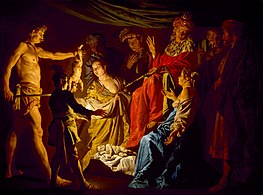
Jan Weenix, Still Life of Game including a Hare, Blackness Grouse, Partridge, Spaniel, and Pigeon in Flight (c. 1680), 157.2 × 182.ii cm.
-

-

Impressionism, postimpressionism, and early modern art [all oil on sail unless noted otherwise]
-
-

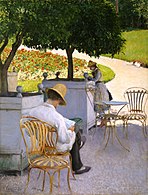
Paul Cézanne, Madame Cézanne in Blue (1888-1890), 74.1 × 61 cm.
-
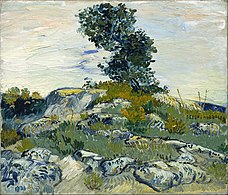
Vincent van Gogh, The Rocks (1888), 54.9 × 65.7 cm.
-
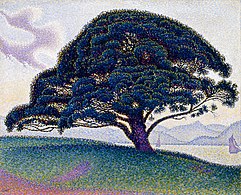
Paul Signac, The Bonaventure Pine (1893), 65.7 × 81 cm.
-
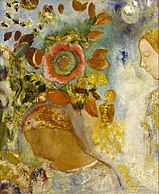
Odilon Redon, Two Young Girls amid Flowers (1912), 62.2 x 51.4 cm.
-
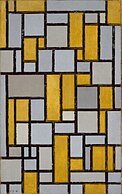
Direction [edit]
Philippe de Montebello directed the museum from 1969 to 1974.[27] During the 28-year tenure of Peter Marzio between 1982 and 2010, the Museum of Fine Arts' yearly attendance increased to roughly two million from 300,000; its operating budget climbed to $52 million from $5 one thousand thousand, and its endowment reached $1 billion[17] (before the 2008 recession dropped its value to about $800 1000000).[27] The museum's permanent collection more tripled in size, to 63,000 works from twenty,000.[28] In 2010, Marzio was the sixth-highest-paid charity chief executive in the country, with compensation in 2008 of $1,054,939.[17] A year later Peter Marzio died in 2010, Gary Tinterow was appointed as the museum's managing director.[29] Mari Carmen Ramírez is a Puerto Rican Art curator and the Wortham Curator of Latin American Art at the Museum of Fine Arts, Houston.[ commendation needed ]
See also [edit]
- Bayou Bend Collection and Gardens
- Ima Hogg
- Samuel Henry Kress
- List of most-visited museums in the United states
- Listing of claims for restitution for Nazi-looted art
Notes [edit]
- ^ The Museum of Fine Arts, Houston: Most, ARTINFO, 2008, retrieved 2008-07-23 [ permanent dead link ]
- ^ The Museum of Fine Arts, Houston: Campus Redevelopment, The Susan and Fayez S. Sarofim Campus (accessed nineteen October 2021)
- ^ "Major Expansion of the Museum of Fine Arts, Houston Moves Forward with the Construction of the Audrey Jones Beck Building". Tfaoi.com. 1924-04-12. Retrieved 2012-09-nineteen .
- ^ "Tips for Visiting - The Museum of Fine Arts, Houston". mfah.org . Retrieved 23 May 2018.
- ^ "Museum of Fine Arts: Sarofim (master) Campus". mfah.org . Retrieved 24 December 2020.
- ^ "Museum of Fine Arts: The Nancy and Rich Kinder Building". mfah.org . Retrieved 22 December 2020.
- ^ ""Ontologically, every affair is unique": Behind the Drapery at the MFAH - OffCite Blog". offcite.org. 16 July 2015. Archived from the original on 22 August 2016. Retrieved 5 April 2018.
- ^ The Museum of Fine Arts, Houston. "The Glassell Collections". Mfah.org. Archived from the original on 2011-02-x. Retrieved 2012-09-19 .
- ^ Villarreal, Ignacio. "Museum of Fine Arts in Houston Opens Nidhika and Pershant Mehta Arts of India Gallery". artdaily.com . Retrieved five April 2018.
- ^ "The Hyatt Foundation". Pritzkerprize.com. Archived from the original on 2011-12-09. Retrieved 2012-09-19 .
- ^ a b c d Pei-Ru Keh (January 19, 2015), Steven Holl Architects' dramatic expansion design for The Museum of Fine Arts in Houston Wallpaper.
- ^ Museum of Fine Arts, Houstom: Sarofim Campus (accessed 24 Dec 2020)
- ^ Robin Pogrebin (Feb vii, 2012), Houston Museum Chooses Architect for Expansion Program New York Times.
- ^ The Museum of Fine Arts, Houston. "Glassell Junior School". Mfah.org. Retrieved 2012-09-19 .
- ^ "Museum of Fine Arts, Houston: Campus Redevelopment". mfah.org . Retrieved 24 December 2020.
- ^ The Museum of Fine Arts, Houston. "Rienzi". Mfah.org. Retrieved 2012-09-19 .
- ^ a b c Rebecca Due south. Cohen (Apr 9, 2011), Replacing a Museum Director Who Was a Rare Find New York Times.
- ^ The Museum of Fine Arts, Houston: Collections (accessed 24 Dec 2020)
- ^ Between Sea and Sky: Blueish and White Ceramics from Persia and Beyond
- ^ Cascone, Sarah (2021-08-18). "Restitution Experts Boom Houston'south Museum of Fine Arts for Refusing to Return a Painting Once Purchased for Hitler'southward Museum". Artnet News . Retrieved 2021-x-17 .
- ^ Edsel, Robert (2021-08-31). "The Museum of Fine Arts, Houston Must Cease Its Head-in-the-Sand Approach to Justice When Information technology Comes to Restitution". Artnet News . Retrieved 2021-ten-17 .
- ^ Villa, Angelica (2021-07-22). "MFA Houston Owns Bellotto Painting Sold Under Duress During Earth War 2, Foundation Claims". ARTnews.com . Retrieved 2021-10-17 .
- ^ "Emden et al five. The Museum of Fine Arts, Houston". www.law360.com . Retrieved 2021-10-17 .
- ^ Cascone, Sarah (2021-10-nineteen). "The Heirs of a Jewish Collector Are Suing the Museum of Fine Arts, Houston, for the Return of a Bellotto Painting". Artnet News. Archived from the original on 2021-10-19. Retrieved 2022-01-26 .
- ^ Hickley, Catherine (2021-08-17). "What Constitutes Art Sales Under Duress? A Dispute Reignites the Question". The New York Times. ISSN 0362-4331. Archived from the original on 2021-09-02. Retrieved 2022-01-26 .
But the Museum of Fine Arts, Houston, which ultimately came to possess the third Bellotto, has rejected the Emden heirs' claims since 2007. Its director, Gary Tinterow, argues that Emden sold the painting voluntarily and, that after conducting provenance research and consulting lawyers, "we ended that we had good title."
- ^ Museum of Fine Arts, Houston. MFAH Backgrounder and Argument: "The Marketplace at Pirna," c. 1764, Bernardo Bellotto. (accessed 17 October 2021)
- ^ a b Douglas Britt (December 12, 2010), Peter Marzio, 67; transformed Houston museum Houston Chronicle.
- ^ William Grimes (Dec xi, 2010), Peter Marzio, Houston Museum Director, Dies at 67 New York Times.
- ^ Carol Vogel (December 1, 2011), Met Veteran Named Managing director of Houston Fine art Museum New York Times.
External links [edit]
- Official website
- Photographs from the Museum of Fine Arts, Houston, hosted past the Portal to Texas History.
- International Eye for the Arts of the Americas at MFAH
- The Museum of Fine Arts, Houston - The Adolpho Leirner Collection of Brazilian Constructive Art at Google Cultural Institute
Source: https://en.wikipedia.org/wiki/Museum_of_Fine_Arts,_Houston
0 Response to "Museum of Fine Arts Houston 1001 Bissonnet St Houston Tx 77005"
إرسال تعليق